
AEC Best Practices Resource Center
The Association Executives Council (AEC) community represents MCAA’s core local-affiliate leadership audience and serves as the primary operational and strategic link between MCAA National and its affiliated local associations. Our community is responsible for governance support, organizational management, member engagement, labor relations, and program delivery at the local level.
AEC members are experienced association professionals, who act as trusted advisors to local boards of directors, stewards of association credibility and financial sustainability. translators of MCAA strategy, programs, and resources into local impact, and conveners between contractors, labor partners, and industry stakeholders.

Have a question about your membership, an upcoming event, or looking for a resource? The MCAA staff is here to provide the expert guidance you need.
LOCAL AFFILIATE RESOURCES
Below are resources geared specifically toward Local Affiliates to support the effective management and operation of their local associations.
Description:
Description:
This in-depth analysis of Alternative Retirement Plan Designs was prepared for MCAA by actuaries Cary Franklin and Jonathan Feldman of Horizon Actuarial Services. It offers a general risk-factor analysis for plan trustees to consider in any more in-depth analysis of particular plan circumstances and plan design options. It focuses on six areas: 1) traditional defined benefit (DB) plans; 2) variable DB plans; 3) cash balance plans; 4) money purchase plans; 5) profit sharing plans; and, 6) proposed new composite plans (not yet enacted into law).
Description:
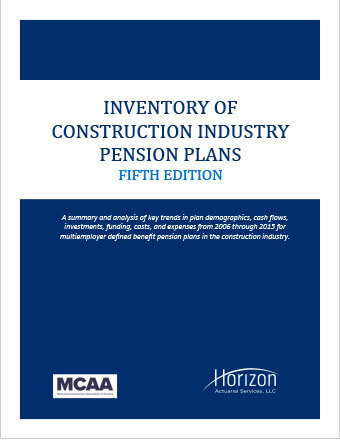
A summary and analysis of key trends in plan demographics, cash flows, investments, funding, costs, and expenses from 2006 through 2015 for multiemployer defined benefit pension plans in the construction industry.
Description:
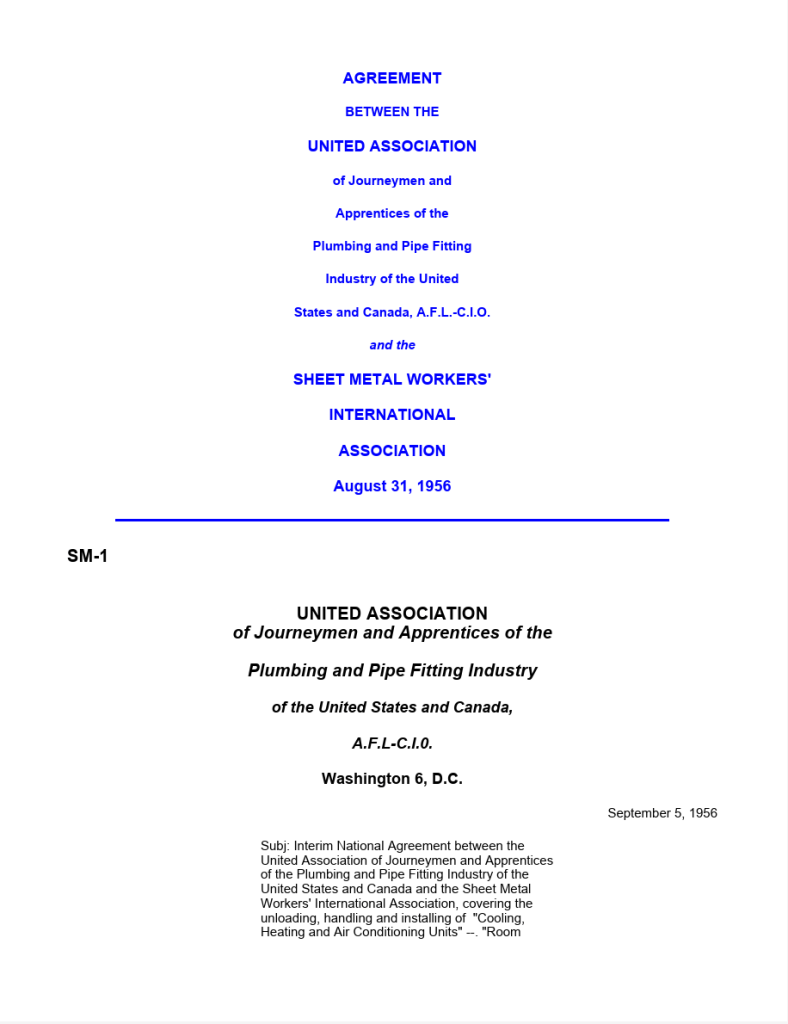
Interim National Agreement between the United Association of Journeymen and Apprentices of the Plumbing and Pipe Fitting Industry of the United States and Canada and the Sheet Metal Workers’ International Association, covering the unloading, handling and installing of “Cooling, Heating and Air Conditioning Units” –. “Room September 5, 1956 Radiators and Enclosures”,—” Kitchen Equipment” and mutual cooperation.
Description:
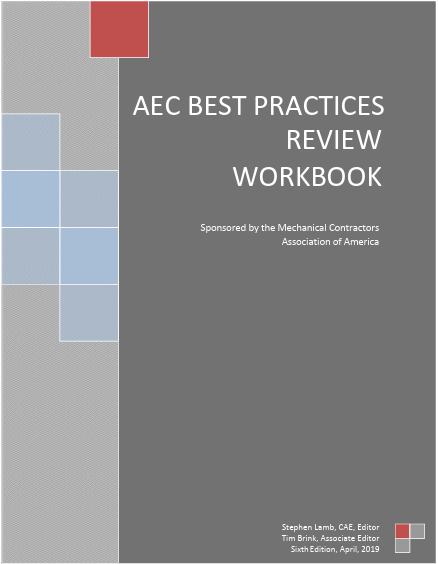
This workbook was originally developed in 2014, and has now been utilized as a part of several dozen local affiliate Best Practices Reviews (BPR’s). The Workbook has several purposes: first, to serve as a sort of “primer” for the newer association executive; second, to as a reminder for experienced executives (for all of those little details that we’ve always meant to get around to); and finally, as a conversation starter during BPR’s.
Description:
For those execs that have earned their ELI Affiliate Executive Director Credential and plan to submit an application for an ELI Credential or ELI Credential Renewal, please review the requirements, along with the allotted credits that have been assigned to each activity. Submit this form to MCAA.
Description:
One of the challenges facing associations today is enabling employees to work productively while also ensuring the security of the IT network and, crucially, the data on it. Given that technology is continually changing, employees play a significant role in IT security. This policy provides a framework for users to follow when accessing IT systems and the data on them. It is intended to act as a guideline for organizations looking to implement or update their own Technology Policy.
Description:
The National Labor Relations Act and what parts are important to us. In this session we look over the NLRA and some of the sections that impact MCA execs today. The words date back to the 1930’s but some elements have current relevance for us. Knowing about these elements help us in separating myth from fact.
Description:
This session addresses the challenges that arise when work stoppages occur directly with a member firm’s employees, such as strikes at contract expiration. It reviews primary picketing, “wobbles,” and strikes resulting from a labor impasse. The discussion also highlights key considerations, including the strike manual, interim agreements, violations of no-strike clauses, and the requirement to notify the FMCS.
Description:
This session outlines the steps an affiliate may take when a member firm faces a work stoppage caused by a labor dispute with another union or employer. It explains the concepts of secondary picketing, secondary boycotts, and area standards boycotts.
Description:
In this session, we will discuss a brief history of organizing and how collective bargaining has evolved over time. Collective bargaining originally developed between a single employer and one group of employees. However, industries like construction are very different because they consist of thousands of small companies rather than a few large ones. Just as one individual employee cannot stand up alone against a company, a small company has little chance of standing up against a large union on its own. That is why the role of a skilled labor relations attorney is so important.
Description:
This session will explore the importance of bargaining rights and the potential risks when they are not properly assigned in writing. We will review the different types of bargaining—including multi-employer, coordinated, and single employer—and discuss how written assignments should be structured, how restrictive they should be, and why securing and maintaining contractor bargaining rights is critical. The session will also address employer ratification, union obligations in bargaining, the impacts of “big dog” bargaining, and briefly cover interim agreements.
Description:
This discussion explores the types of disputes that can arise under collective bargaining agreements and the processes used to resolve them. It covers grievances, whether filed by employees, unions, or employers, and the role of grievance committees at both the local and IRC levels. The session also reviews different forms of arbitration and touches on jurisdictional disputes, which will be examined further in a later module.
Description:
This session explains the organizational structure of the UA, beginning with its national leadership and affiliates under the BCTD–AFL-CIO. It outlines the roles of Special Representatives and International Representatives, as well as how responsibilities flow to the local level. The discussion also highlights the structure of local unions, including the Business Manager, agents, Executive Board, organizers, and rank-and-file members.
Description:
This session uses examples to explore how national agreements function and the challenges they may create for local affiliates. It reviews agreements that can supersede local area contracts, including the role of TAUC in relation to the NMA. The discussion also addresses which agreements exclude or limit industry funds and how to handle situations where an out-of-town contractor reports that a union will not honor a national agreement.
Description:
This session examines the various employee classifications within the UA and collective bargaining agreements and how they affect employers. It covers roles such as journeymen, apprentices, foremen, and superintendents, as well as light commercial, service, and HVACR classifications. The discussion highlights the significance of the hiring hall for both employers and the union, clarifying who can perform specific work and why. It also reviews how UA designations may differ from local agreements and the issues that can arise.
Description:
This session explores how unions claim work and why “trade jurisdiction” is central to their identity and authority. It traces the history of craft workers defining work processes, and explains how jurisdiction is outlined in both the UA Constitution and collective bargaining agreements. The discussion covers the evolution of work process definitions, conflicts such as plumbers versus fitters, and jurisdictional issues between the AFL-CIO and UBC.
Description:
This session focuses on how employers should properly assign work, emphasizing their duty and obligation in the process. It reviews who has the authority to make these determinations and the key factors that must be considered. The discussion also addresses potential disputes, the role of the “Greenbook” and 10(k) proceedings, and the use of memos of assignment. Finally, it examines how improper assignments can lead to work stoppages and related challenges.
Description:
These sessions provide an overview of Trusts and their connection to collective bargaining. They explain Taft-Hartley Trusts along with other benefit-related trusts, highlighting their role in labor-management relations. The discussion also emphasizes why it is important for employers to exercise their right to allocate raises. Finally, it explores the process for allocating a raise and the distinction between benefit plan design and bargaining.
Description:
These sessions provide an overview of Trusts and their connection to collective bargaining. They explain Taft-Hartley Trusts along with other benefit-related trusts, highlighting their role in labor-management relations. The discussion also emphasizes why it is important for employers to exercise their right to allocate raises. Finally, it explores the process for allocating a raise and the distinction between benefit plan design and bargaining.
FEATURED RESOURCE
AEC Jurisdiction Map
The map captures essential jurisdictional details and consolidates every state, county, local, and affiliate into a single, comprehensive database. This resource is designed to provide quick and seamless access to contacts, contracts, and wage sheets—empowering you to better serve your members with greater speed and efficiency.

INDUSTRY-WIDE RESOURCES
Below are highlighted tools and nationally recognized resources are designed to support contractor members and represent key programs, services, and information affiliates may reference, share, or elevate at the local level.
Description:
The National Service and Maintenance Agreement is an agreement negotiated and administered by the United Association of Journeymen and Apprentices of the Plumbing and Pipefitting Industry (UA) and the Mechanical Service Contractors of America (MSCA) and is a signed contract between the UA and individual mechanical service contracting firms who apply and qualify. The Agreement is a nationally recognized tool that helps contractors provide quality, consistent service to their customers throughout the country and helps reclaim lost market share.
Description:
This guide provides practical information to help mechanical contractors prepare properly for bargaining, understand what to expect, avoid common pitfalls, and achieve better results. That includes being familiar with both the policy/legal context and the real, pragmatic steps of bargaining, which are presented in plain English.
Description:
This essential guide provides mechanical contractors and association leaders with practical, legally grounded advice for organizing, administering, and maximizing the impact of Industry Improvement Funds (IIFs). Covering topics from legal compliance and governance to financial management, tax issues, and program development, it offers clear explanations, model documents, and answers to frequently asked questions to support effective fund operations and industry advancement.
Description:
MCAA produced this document to assist member companies and their accountants in complying with the Financial Accounting Standards Board’s (FASB) disclosure requirements pertaining to an employer’s participation in multiemployer defined benefit pension plans. Questions? Please contact John McNerney.
Description:
At MCAA, we pledge to deliver the highest quality educational resources, best-in-class networking, labor relations, and legislative advocacy with unmatched member benefits. We’ll be your trusted guide and voice in the ever-evolving mechanical contracting industry, helping you navigate change and embrace new opportunities with confidence.
LATEST AEC NEWS
-
2025 AEC Best Practices Conference Brought Association Leaders Together in Boston
MCAA’s 2025 AEC Best Practices Conference, held July 27–30 at The Westin Copley Place in Boston, MA, drew AEC professionals from across the country for three…
-
MCAA Mourns the Passing of Thomas J. Wanner
Thomas J. Wanner, retired Executive Director of the MCA/MSCA of Cleveland, Inc. and a past chair of MCAA’s Association Executives Council, passed away on March 7,…
-
Dues Increase Coming in 2025
The 2025 dues rates for construction and service hours will increase to $.10 per labor hour effective January 1, 2025. The minimum dues assessment is based…
-
Randall Chenworth Is ARCA/MCA’s New Executive Director
Randall Chenworth is the new Executive Director of ARCA/MCA of Southern California, effective August 1, 2024. He is excited to continue the legacy of excellence and innovation…
-
Randy Drennen Will Join the Rocky Mountain MCA
Randy Drennen will become the Rocky Mountain MCA’s (RMMCA) next Executive Director on July 9, 2024. He brings over 25 years of experience to the role,…
-
Anthony Saporito Announces Retirement
Anthony (Tony) Saporito, Executive Vice President of the MCA/MSCA of New York, Inc. (MCANY), has announced his upcoming retirement. He said, “I had a great time…
-
MCA of Western Washington Names Cowper as its Next Executive Director
The MCA of Western Washington (MCAWW) has appointed Robin Cowper as its Executive Director effective January 1, 2024. “Robin is well positioned and well qualified for this role and…
-
AEC Recognizes Chip Martin
MCAA’s Association Executives Council (AEC) recognized outgoing Chair Chip Martin at the conclusion of the 2023 AEC Best Practices Conference on August 2, 2023 in Carlsbad,…
-
MCA of Eastern Missouri Names Carmosino as Interim Executive Director
Carly Carmosino has assumed the role of Interim Executive Director at the Mechanical Contractors Association (MCA) of Eastern Missouri, an MCAA affiliate. “Carly comes prepared for…
-
Phil Petillo Is the MCA of New Jersey’s New Executive Director
Phil Petillo is the MCA of New Jersey’s (MCANJ) new executive director. Phil has been the association’s education director for 10 years. During that time, he…
-
Stacy Zerr Will Join the MCA of Kansas City
Stacy Zerr will become the MCA of Kansas City’s (MCAKC) next Executive Director on October 31, 2022. She brings over 24 years of mechanical contracting experience…
-
Ali Brown Has Joined the MCA-Omaha Staff
Ali Brown has joined the staff at MCA-Omaha as the Associate Executive. She replaces Michele Hoffman, who is now MCAA’s Director, Career Development. Ali’s background made…
-
The Greater Boston PCA Is MCAA’s Newest Affiliate
MCAA is pleased to welcome the Greater Boston PCA as our newest affiliated association. The coalition of roughly 60 union plumbing businesses is based out of…
FEATURED EVENT
2026 AEC Best Practices Conference
July 27-29, 2026
Sonoma, CA
Save the date for the AEC Best Practices Conference, where local association executives come together to learn from peers, share proven strategies, and gain practical tools to lead stronger, more effective organizations.